

Part II of a two-part series on the Mecca Pact and the changing geometry of Middle Eastern security
The Mecca Pact invites comparison with NATO because of its mutual-defence clause. In almost every other respect, the comparison remains premature.
Saudi Arabia, Turkey and Pakistan agreed on August 7th that an armed attack on one would be treated as an attack on all. Yet there is no NATO-style integrated command. Detailed force commitments remain unclear, and members would still have to consult over the scale and form of assistance required after an attack.
That ambiguity could prove a serious weakness. A defence pact whose members cannot predict what the others will do in a crisis may deter less than its language suggests.
But looseness may also reflect the political environment in which the pact was created.
The three members want cooperation without necessarily wanting the same foreign policy. Saudi Arabia seeks stronger deterrence after a regional war exposed the vulnerability of Gulf infrastructure and airspace. Turkey wants greater strategic autonomy and a larger regional role. Pakistan values Gulf support and has demonstrated its ability to provide military manpower there, while its principal security calculations remain rooted in South Asia.
A rigid alliance would demand greater convergence over threats, military planning and strategic priorities. The Mecca Pact instead sacrifices some credibility in exchange for room to manoeuvre.
Whether that trade is sustainable remains unknown.
The more important change, however, lies outside the pact.
Twenty years ago, governments seeking greater strategic autonomy in the Middle East faced a narrower set of external options. The United States possessed an extraordinary concentration of military, technological, diplomatic and financial power. Washington did not control every regional government, but it heavily shaped the range of realistic choices available to many of them.
American power remains formidable. Its bases, intelligence relationships, training networks and weapons systems remain deeply embedded across the region. The United States supplied 54% of major arms imported into the Middle East in 2021-25 and 77% of Saudi Arabia’s. Its ability to conduct sustained high-intensity military operations remains far beyond anything China has demonstrated there.
What has changed is the number of alternatives available alongside it.
Strategic autonomy requires alternatives.
China increasingly provides them.
Its role now spans trade, energy, infrastructure, capital, technology, diplomacy and, in selected relationships, defence-industrial capacity. None of these connections individually substitutes for the American security system. Together, however, they reduce the cost of relying on it less exclusively.
China did not create Saudi or Turkish ambitions for strategic autonomy. Those ambitions have their own histories and domestic logic. Beijing has helped make them easier to pursue.
Pakistan provides the clearest military example. Chinese systems absorbed into the Pakistani armed forces can now appear in Gulf security operations without a Chinese defence guarantee or Chinese chain of command. The first essay in this series described this as the second journey of military technology.
The broader network is economic and diplomatic.
China maintains extensive ties with Saudi Arabia while remaining Iran’s largest trading partner and the principal destination for Iranian oil. In 2023 Beijing hosted the agreement restoring diplomatic relations between Riyadh and Tehran after seven years of estrangement. Iraqi and Omani diplomacy had prepared much of the ground, and Chinese leverage over either government should not be exaggerated. But the episode showed that Beijing could remain useful on both sides of one of the region’s deepest rivalries.
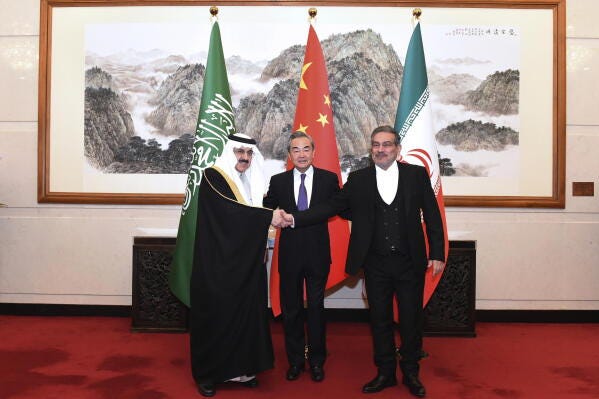
This year’s war exposed the limit of that position as clearly as its value. Gulf governments have tested whether Chinese access to Tehran can produce Iranian restraint. Beijing possesses channels that many Western governments lack. Access has not translated into command.
That distinction matters.
China is expanding the options available to Middle Eastern states. It does not control the choices those options make possible.
Nor should the contrast with the United States be pushed too far.
America is itself the centre of enormous diplomatic, technological, financial and military networks. China does not uniquely represent “connectivity”, just as the United States does not simply represent “blocs”. The more useful distinction lies in the obligations attached to their present roles.
Washington provides much deeper security guarantees. Those guarantees require bases, intelligence, interoperability, planning and the credible possibility that American forces may fight. Governments benefiting from such protection inevitably face greater pressure to coordinate strategy with the state providing it.
China has so far accepted much shallower military obligations in the Middle East. That makes simultaneous relationships with Saudi Arabia, Iran, Pakistan and Turkey easier to sustain.
This is a difference of present function, not an immutable division of labour. If Beijing eventually assumed much larger security burdens in the region, it too would probably seek greater coordination from governments depending on Chinese protection.
For the moment, regional powers can draw on both kinds of engagement.
Turkey shows what this looks like in practice.
Ankara remains a NATO member and continues to derive substantial military value from the alliance. At the same time it has built a more autonomous defence industry, expanded its role in the Gulf, cultivated influence across the Turkic world and sought deeper economic relations with China. Political friction with Beijing, including over the Uyghur issue, has not prevented that engagement.
Turkey’s strategic autonomy therefore does not depend on escaping major systems. It derives partly from being connected to several of them at once.
That makes Ankara a useful guide to the possible evolution of the Mecca Pact.
Turkey has already expressed interest in widening the arrangement, with Egypt mentioned as a possible participant. Iran’s initial response has also been more measured than the description of a “Sunni NATO” would imply. Tehran has said it does not regard the pact as inherently directed against it and has spoken favourably about greater regional responsibility for security.
Those statements do not prove that a new regional order is emerging. They simply widen the institutional possibilities.
One possible configuration would be a layered security architecture.
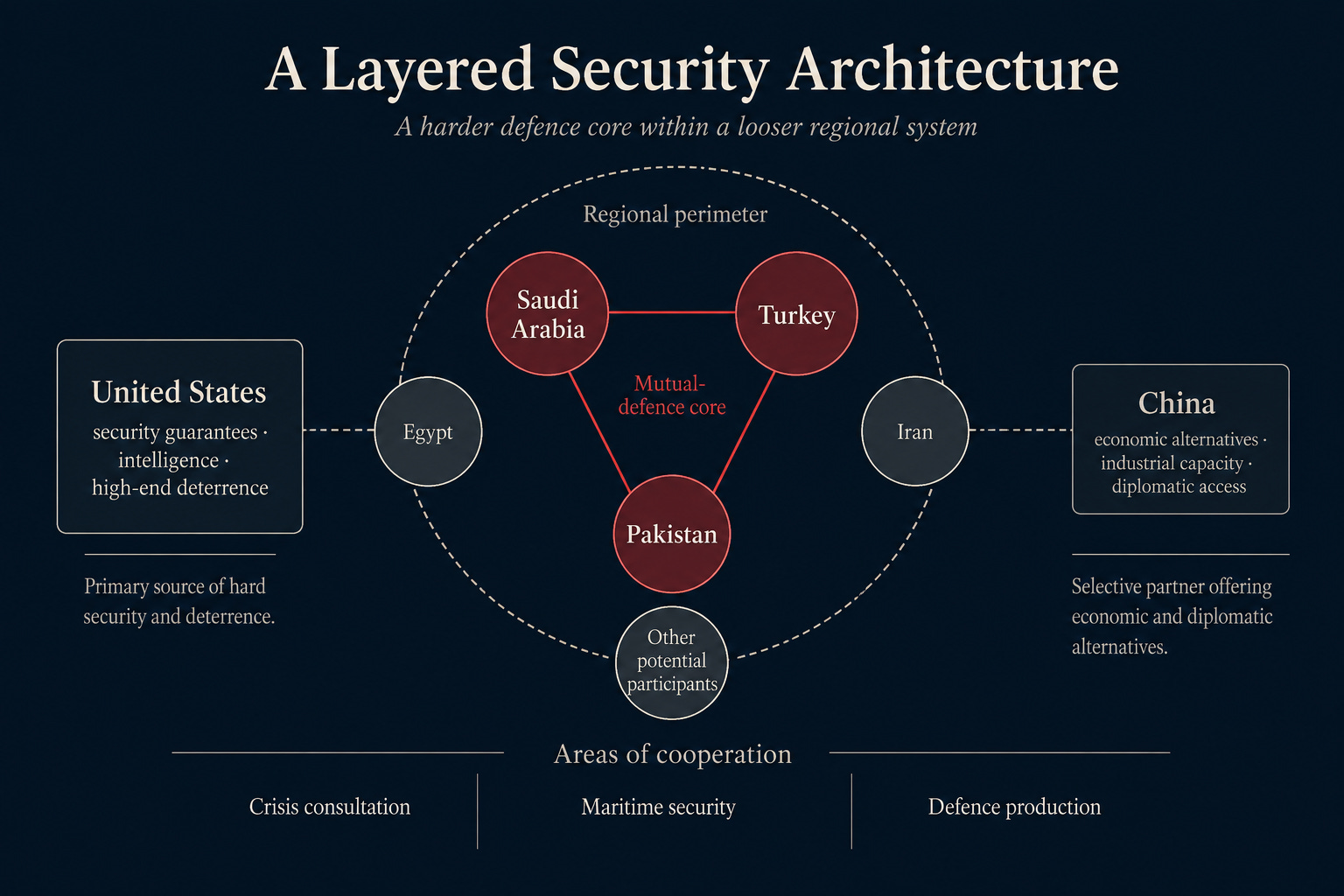
At its centre would sit a harder mutual-defence core: states willing to accept direct security obligations to one another. Around it could develop a looser perimeter of maritime security, crisis consultation, intelligence cooperation, defence production and diplomatic mechanisms involving countries that never accept the same defence commitments.
Such a structure would allow members to retain different weapons suppliers, different great-power relationships and different views of regional threats.
It would lack NATO’s cohesion.
It might also accommodate combinations that NATO-style alignment would make much harder.
There is no reason to assume this path will prevail.
A renewed Iranian threat, another major war or an early failure of the pact’s deterrent credibility could push its members in the opposite direction. Joint planning would become more important. Military interoperability could outweigh diplomatic flexibility. Threat perceptions that are currently different could converge under pressure.
Those conditions would increase the value of precisely the capabilities embedded in the American-led security system: command integration, intelligence, logistical depth and credible high-end military guarantees.
They would also make China’s position harder. Beijing’s ability to maintain useful relationships with Iran and its Gulf rivals depends partly on those relationships remaining sufficiently compartmentalised. A more sharply divided region would reduce that room.
The future of the pact therefore turns on a recognisable institutional fork.
If common threats dominate, defence obligations harden and command structures deepen, bloc logic will strengthen.
If membership widens while governments preserve different external relationships, and if the new institutions coordinate more than they command, concert logic will gain ground.
The distinction matters because regional powers are already exploiting the strategic space created by overlapping external systems.
Saudi Arabia can seek additional deterrence without discarding American protection. Turkey can remain inside NATO while widening its strategic relationships. Pakistan can carry Chinese military technology into Gulf security without becoming an instrument of Chinese policy.
Their autonomy is real, but it is not self-generated. The room in which they manoeuvre is partly produced by competition among the larger systems surrounding them.
Great-power rivalry is becoming one of the resources Middle Eastern states use to widen that room.
The Mecca Pact may still harden into a conventional alliance. It may remain loose enough to anchor a layered regional security system. It may fail to acquire much operational significance at all.
For now, its importance lies less in which future has already been chosen than in the fact that several have become plausible.
Outside powers will continue to shape Middle Eastern security.
What is increasingly uncertain is whether any one of them can still shape it alone.